Showing posts with label Product Review. Show all posts

Monday, September 21, 2015

SimuCase Virtual Case Studies

Have you heard of SpeechPathology.com?  They have a new case study series called SimuCase, and it is awesome!!

It was originally used by students in Ohio, but they are expanding it to all SLPs to use to hone their skills.

Check out this video tour:


This site is designed to help walk you through the assessment process and really fine tune your skills.  It walks you through assessment, diagnosis, and making recommendations.   They are real cases that people have submitted.  The videos are animated, but you get to hear the actual voices and work samples of these clients.  Experts in the various areas have reviewed these cases and the scoring is based on their recommendations.

I believe this is an extremely valuable tool for students and SLPs to use.   It allows you to practice your skills and shows you what "good" versus "excellent" skills are.  SimuCase allows users to analyze which team members are necessary and which types of questions will get the point quickly without being redundant.  I would recommend this to anyone looking to further their skills.  It's definitely something I wish I had in graduate school!  Another thing I really like is that it has case studies for a wide variety of ages and disorders--it includes preschool, school age, and adults with diagnoses of language disorder, fluency disorder, TBI, dysphonia, stroke, articulation disorder, voice disorder, and developmental delay. It is extremely comprehension in the variety of the clients and in the process of gathering a case history, selecting assessments, diagnosing, and making recommendations.

Now I know the question on everyone's mind is about CEUs.  Right now, they are not offered as part of it, but they are working on it!  So definitely check back if you need CEUs because this is worth your time!  They are also planning on adding more cases over time.

If interested, you can check it out here!

What do you think?  Would you use this?

Note:  Trial access was provided for my review.  No other compensation was received.  All opinions expressed are mine. 

post signature

Friday, April 17, 2015

Everyday Speech Social Skills Videos {product review + giveaway}

Are you familiar with Everyday Speech?  They created the apps called Let's Be Social, Let's Learn Emotions, and Let's Use Language!  They have had so much success with the videos included included in the Let's Be Social app, that they decided to make more.  I was so excited when they told me about this because these are PERFECT for my students!   Check them out below:


Everyday Speech is selling these videos as a stand alone package.  You can buy them individually, in bundles, or subscribe for full access!  You will be able to watch these videos from a computer or tablet.  You will also be able to stream them or download them for later use.

Here is the list of videos that they plan to include in this package:


These videos use real kids and discuss real life scenarios!  There are options for younger kids and older kids.  Here's some sneak peeks of what the videos may include.


These videos are such a fabulous resource.  I am so thankful for them.  As I mentioned, they are perfect for a couple of my students.  They correlate perfectly to the students' IEP goals!  This videos are also short--about 2 minutes on average.  Here's an example of a video:


Here's the amazing part:  Everyday Speech is giving away TWO free packages to Home Sweet Speech Room readers!  All you have to do is sign up for their waiting list!

For the site that has the most people sign up for the waiting list, they are giving EVERYONE who signed up through that site a free package.  WOW!!  

Wait...there's more.  Everyone who signs up for the waiting list with the link below will also get 50% off the package if you do not win a free one!  Isn't that amazing?

In summary, signing up for the waitlist will get you these things:
-50% off the video package price
-An entry to win one of two free packages for Home Sweet Speech Room readers
-If we have the most people sign up, everyone who signed up on here gets a free package!

So sign up HERE!

Once you do that, tell me what you think! I'd love to hear it!

post signature

Thursday, April 9, 2015

Power Books: Conversation {product review}

I recently had the opportunity to check out this new product from Turning Points Media,  Power Books: Conversation.  Read about them below!


Description (straight from Turning Points Media's website):
"Power Books: Conversation is a resource of lesson plans and materials for teaching basic conversational skills to children with high functioning autism or social communication disorder. This is a downloadable product that comes with a pdf file for the book and also two audio files: The "Conversation Song" and an instrumental version."

These lessons were created by Joe Rothstein, who is an SLP in California.  He basis his work on current research, which is so so so important these days!

The book includes lessons for the following areas:
-whole body listening (body positioning and using you eyes)
-staying on topic (reciprocal statements and asking questions)
-expanding topics
-talking too much
-background/ context
-tact

Each lesson in the program includes the following elements:
-direct instruction
-guided practice
-independent practice
-homework
-redirection cues

Here's an example of a lesson:


Other pages in the book include supplemental pictures to go along with each lesson, such as these conversation starters or emotions images.


Also included in this download is the conversation song and lyrics for those songs! Check out a clip of the song here:


Here's what I love about Power Books: Conversation:
-I love that it's research based!  This is so so so important. 
-I like the different levels of instruction/practice for the students.  
-I like that there are included multiple lessons under each topic.
-I like the songs!  My students love music, so this was a fun way to add to their learning. 
-I like how easy it would be to prepare these lessons. It's all laid out for you.
-I like that, even though they are laid out for you, you can adapt them to your students' needs.

If there's one thing that I would like to see in future updates, it would be real photos for the emotions.  The illustrations used are not terrible, by any means.  Sometimes my students with autism have difficulty with illustrations and benefit from real images.  Just a personal preference and a suggestion based on what works for my students.

If you're interested in this book, you can purchase it from Turning Points Media here!  They are listed for $10.00 each and contain a digital download of the book and recordings of the Conversation Song!

What do you think?  Would you use these in your speech room?

post signature

Tuesday, January 20, 2015

Task Cards for Language Skills {product review}

Note: This post contains affiliate links for your convenience. 
 
This week on Educents, there is an offer for Printable Task Cards for Language Skills!  Educents has been a great resource for me for educational activities, but I always get excited when I see something from a fellow SLP! 


Let's start with the basics, directly from Educents:


"Concepts covered:

ELA, vocabulary, grammar, reading comprehension, word meanings, prepositions
What's included?

  • 130 cards addressing categorization; some with visual cues and some without, with a total of 84 different questions.
  • 24 different multiple meaning words cards. Many words in English language have more than 1 meaning.  For some students with severe language disorders, the ability to learn a limited number of vocabulary words for a larger number of contexts is an advantage.  For others with less severe language disorders, this can be confusing.  Reading comprehension can be impacted by inability to understand word meanings.
  • 48 cards addressing plural nouns,  24 cards for possessive and 20 for pronouns.  Some have picture choices for responding.
  • 32 prepositions cards, in a multiple choice format, with visual cues.  Those cards are repeated without the choices, for a fill-in format. There is a game board and a spinner, with answer forms and student response forms for all sets."

That's a lot for one set, right?    Well this week, I had the opportunity to check out the "category" section.  Like it says above, there are 130 cards in total.  

There are various types of questions on these cards.  One: Find the category with and without visuals. 

 There are also multiple choice questions:

Name....

Questions:

What I Like:
I like that there are so many different task cards, including but not limited to categories. I could find task cards in this set, one for every language goal my students have.   I like that these task cards provide many opportunities for my students to work on their goals.  I really like that she included some with visual supports. 

What I'd Like To See Improved:
This is not a huge deal, but there is a lot of waste space on these cards.  There is a lot of white space.  While this is appreciated for some students, there is not a lot of visual appeal to the cards.  

If you're interested in this set, you can get it on Educents HERE this week!  It's 35% off it's normal price of $32, so you can get all of the activities for $21! 

post signature

Monday, November 24, 2014

Peekapak {product review}

Note: There are affiliate links in this post for your convenience. 

Today, I'm bringing you something completely different than I ever have done before.  Have you heard of Birchbox?  It's a monthly subscription service that sends you a box of makeup every month.  I've always wondered about having a similar concept for SLPs or teachers.  Today, I bring you Peekapak!


What is Peekapak? 
I'm glad you asked!   It's a monthly subscription service that includes toys for storytelling and play-based learning. There's an original storybook, a craft, and other activities to help the kids learn!


What was inside mine?
-Safety scissors
-Storybook
-Craft supplies (tape, crayons, popsicle sticks, string,small tub)
-Tanogram puzzle pieces
-Tanogram puzzle pages
-A toilet paper roll to make a kaledioscope
-Small, colorful beads/tokens
-Shiny paper
-Wax paper
-Paper figurines for story retell
-Peekapak Pals (paper dolls)
-Instructions
-Note from the co-founders


Activities:
In my Peekapak, I had several activities.  Making a parachute, making a kaleidoscope, tanograms, and reading a book were just a couple examples. There were also popsicle sticks and paper dolls for story retell.


How to use in the speech world:
I think these boxes are perfect for our preschool or lower elementary friends.  The focus of my box was on shapes, which is what my kindergarten friends are working on in first and second quarter.  The tanograms (or any of the crafts) would be great for following directions.  The popsicle sticks and paper dolls also be great for story retell and sequencing. For our articulation students, read the story (or have them read it) and say the words with their sound(s) in them!  

Interested in Peekapak?   Head on over here!  Use the code SPECIAL10 to receive $10 off your Peekapak!


Have fun!!

post signature

Friday, May 30, 2014

Speech-Language Assessment Checklist for School-Aged Children {review}

Today, I am super excited to bring you a great product from my friend Tatyana over at Smart Speech Therapy LLC.   She just updated one of her very first products called Speech-Language Assessment Checklist for School-Aged Children, and it is truly great!   Check out some of the features below and why it is a great product. 


Here's a description straight from her blog:
This updated and expanded 17 page guide, which now includes reading and writing sections, was created to assist speech language pathologists in the decision making process of how to select assessment instruments and prioritize assessment for school age children. The goal is to eliminate administration of unnecessary or irrelevant tests and focus on the administration of instruments directly targeting the areas of difficulty that the child presents with.
First, there is a handout for the caregivers and the classroom teacher to fill out.  This allows for their input to be heard and may highlight some deficit areas that aren't necessarily seen during the evaluation.  This checklist is extremely comprehensive and covers the areas of receptive language, memory/attention/sequencing, expressive language, vocabulary, narratives/storytelling, speech, voice, prosody, resonance, phonological awareness, reading, writing, problem solving, pragmatic language skills, social emotional development, and executive functioning.  

The next section is a list of suggested tests for school-aged children.  These are broken down by area--articulation, fluency, general language, narrative assessments, vocabulary/ semantic flexibility, auditory processing and phonological awareness, problem solving/ social language development/ executive function, and reading/writing/spelling. 

She then includes a list of suggestions for testing based on the deficit areas and age of the child.  For example, if the child is elementary age and has auditory processing and phonological awareness deficits, she recommends the CELF and the CTOPP.  

The last section is a supplemental section for caregivers and teachers to help collect data.  These forms are recommended if the checklist comes back with many deficit areas/ areas of difficulty.  The teacher can indicate one of the four ratings for each item:  always, often, sometimes, or rarely.  The items to be rated coordinate with the areas listed above (on the checklist).  

From the results of these measures, the SLP will assess the most severely impaired areas according to the checklist and data form.  

Why It's Effective:
So you may be thinking, I already have a system or I was taught to do X Y and Z, so why this?  Well let me tell you this will speed up the whole assessment process.  Sometimes, we don't get enough information from case history.  This isn't intentional necessarily, but I have learned that they can always be more complete! This checklist will allow the SLP to obtain more specific information and therefore ask more specific questions later on if needed.  

As a new clinician, I have sometimes struggled with giving a full comprehensive test like the CELF and still not knowing what the child is having difficulty with.  I could spend hours analyzing a test, error by error, to determine exactly what the child is struggling with.  For example, on the CELF, I could break down the sentences to determine which types of words they have the most difficulty with.  But is that practical?  No way!  By selecting more specific tests, with the help of this checklist, the child's strengths and difficulty areas may become obvious faster.  You save time yourself and the child can be seen faster.  


Why I love it:
-This is a super helpful guide for new SLPs like me.  It is also extremely helpful for seasoned SLPs and allows the assessment process to be extremely efficient and prioritize which assessments are needed.  
-The instructions are straight-forward. 
-It is an effective way to select assessments. 
-It allows for fairly extensive input by the caregivers and teachers.  
-It may lead to a faster diagnostic decision. 
-The checklist can also help guide intervention. 

What do you think?   Would this help you?   If so, you can find it on her online store here.  It is currently listed at $10.99.

Note: Due to issues with copyright and photocopying materials, there cannot be more pictures posted.  Sorry for the inconvenience.  I tried my best to describe the pages for you.  

post signature

Sunday, January 26, 2014

Sand and Water Sensory Table {product review}

Note: A copy of this product and another were sent for my review.  No other compensation was received.  All opinions expressed are mine.  This post contains affiliate links for your convenience.  

I'm so excited to show you a portion of a brand new packet on Educents right now: Preschool Rocks!  This product contains 19 different activities, all geared towards preschoolers. The following are the activities included:


One of the activities called Sand and Water Sensory Table!  I was so excited when I was asked to review this part because one of my favorite activities to do with preschoolers is the sensory table.  We put sand, water, noodles, and various other materials in our sensory table.  Generally, we tend to avoid food because of allergies.


The packet contains the following activities:

  •  Brain Research (which supports using the sand and water table
  •  Teaching Tips
  •  Purpose of Activities
  • Twelve sand table cards
  • Fourteen water table cards
  • Response Sheets
  • Posters (to use with task card activities)
  • Thematic Word Cards

Brain Research-
These are short statements on what the research says on sensory tables and the brain.  I love seeing that it's research based!

Teaching Tips-
These are options if you do not have a commercial sensory table.  These include using plastic bins and baby baths.

Purpose of Activities-
This page lists the vocabulary words you can target with a sensory table as well as other purposes (motor planning, problem solving, etc).

Sand Table Cards-
First, the author gives alternatives to using sand.  These are listed by theme, which is great, too!


The cards all look very similar with the activities listed:


Water Table-
The cards look the same as with the sand table, describing the activities and variations you can do with them.

Response Sheets-
Some of the activities require the students to make notes/record their findings.  They look similar to this:


Posters-
This packet also contains posters to accompany the activities. These are to be laminated.


Thematic Word Cards-
These are to be printed, laminated, cut apart, and placed in the sand table.  Students will search the sand table for these cars and match the initial letter with the letter magnet.

Overall, I love this packet!  I would definitely recommend it to others.  I love that these activities are being done by teachers and still target our goals as SLPs!!   I love how many different activity suggestions the author gives, too.  This is most definitely a packet I will be using in the future!

Again, you can find this as part of a larger bundle here!  Hope you love it!

post signature

Wednesday, June 26, 2013

Swish Junior {Product Review}

I'm always on the lookout for new games to play in therapy with my students.  They definitely have their favorites, but they need extra motivation sometimes.  Honestly, sometimes it's ME who needs the change.  Either way, new games are good, right?  I recently had the opportunity to play Swish Junior with my students.  It is a brand new game from Think Fun.  This post contains affiliate links for your convenience.


Where to Buy It:
Swish Junior is available from Think Fun or on Amazon.

The Basics:
The box comes with a set of see-through cards, instructions for play, and a bag for easy storage of the cards.

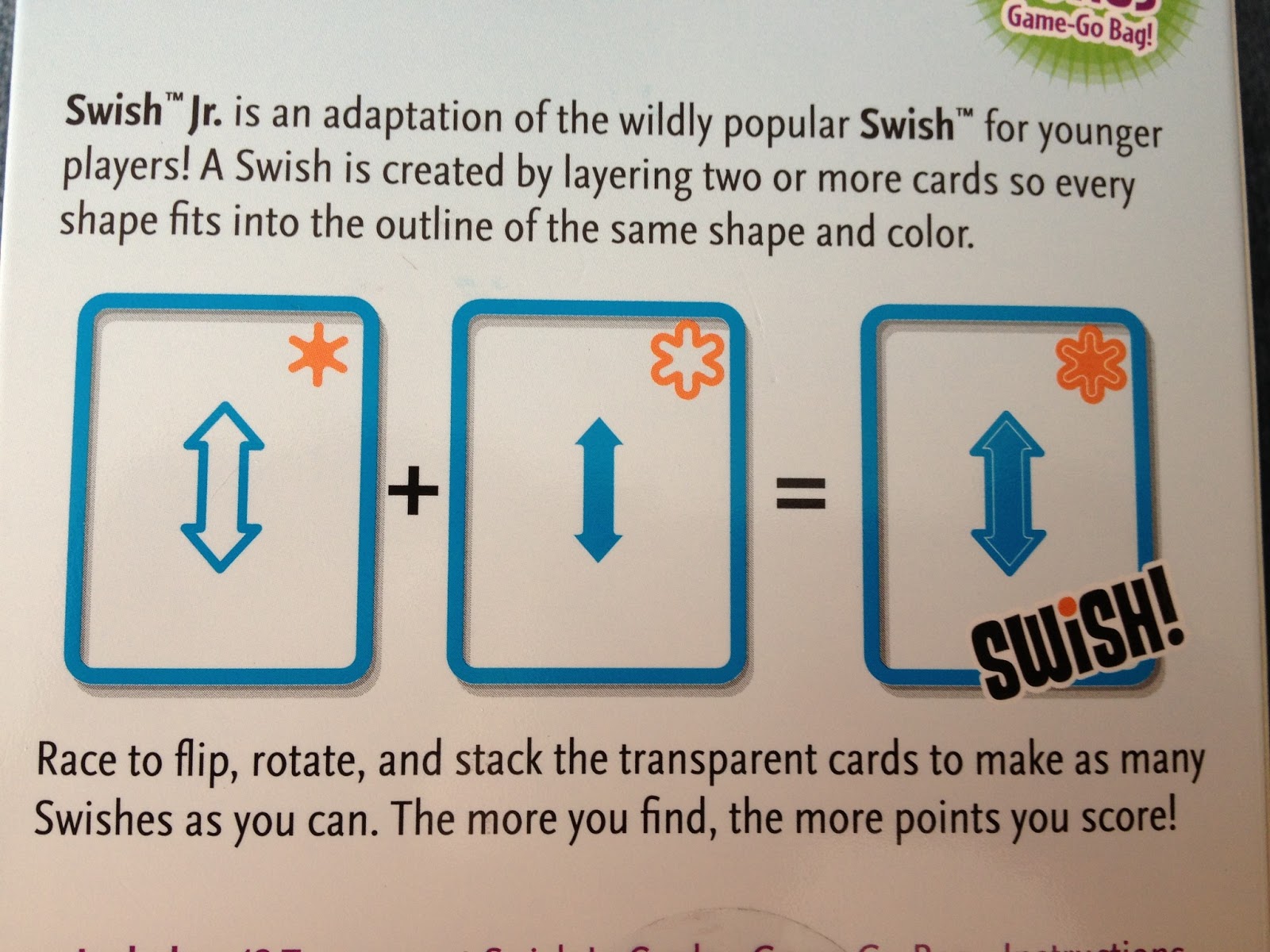
To play, place a set of cards on the table. Place them in rows (maybe rows of 3).  To create a "swish" or a match, an outline of a shape will match exactly with a filled in shape on another card.  BOTH shapes on the card must create a swish with the shapes on the other cards for it to be a complete swish.  Look at the cards to see if they match.  As soon as they match, call it out!  Whoever has the most swishes wins!


A swish can be with more than 2 cards, too.  As long as the outlined shapes match up with the filled-in shapes, it doesn't matter how many cards it takes to complete the swish!  WHOA!


What You Can Target:
-Spatial skills
-Visual skills
-Matching skills
-Social skills
-Basic concepts (prepositions, colors, etc)
-Attention to task

Why I Love It:
-This game is unlike anything I've every seen before!  See-through cards!
-As always, you can target so much with it.
-It really challenges students to think about it!
-It's a game that can be used with children AND adults.
-It's easy to store-doesn't take up much space.
-You can make it multi-player or just use it with one person.

In My Speech Room:
We used it last week in therapy, and my students loved it!  I thought that they would struggle with it at first, but they picked it up right away!  I guess I underestimated their abilities.  They easily got matching just 2 cards.  I challenged them to try and match 3 or 4 cards, but that's when the breakdown happened.  That's ok, though!  We will keep working on it.

Want to purchase this?  You can buy it from ThinkFun's website or from Amazon.

Swish Junior is sure to be a new favorite in my speech room.  I hope your students love it as much as I do!

Disclaimer: This product was provided for me to review.  No other compensation was received. All opinions expressed are mine.  

ALSO- Google Reader is disappearing soon.  Be sure to follow with Bloglovin' or Feedly. Follow my blog with Bloglovin
post signature

Thursday, May 30, 2013

Roll and Play {Product Review}


I was walking around my local grocery/super store and found this AWESOME game!  I had NO idea that it was developed by a speech and language product company, since it was sitting with all other board games.  I read the description and knew that I simply could not pass it up!  It is PERFECT for preschool speech, language, and motor therapy activities!  There are affiliate links in this post for your convenience.


Allow me to introduce you to Roll and Play from Think Fun! The package states that students will "have fun and learn," and I definitely agree!! 

If you would like to get this game for your speech room or your own children, click on the picture below:


The Basics:
Before playing, separate the cards into the different color stacks on the table.  On his or her turn, a student/child will take the huge die and roll it.  Then, they pick up a card that matches the color they rolled and perform the action on the card.  Some of the actions include, "Give one hug" or "Find something red."


What's Included:
The package comes with one die and a set of 48 activity cards.  It also comes with instructions and a Parent's Guide.

Why I Love It:
- It can target SOOOOO many different goals.  Examples include colors, counting, and following directions.
-It's easy to store--the cards fit into a pocket in the die.
-It's fun and gets the students moving!
-The pictures are simple and easy to understand.
-There's writing on the cards for those students who can read, too!

Modification for Older Students:
One modification to make it suitable for older students would be to have them roll the die more than once.  That way, they have to follow multiple directions.  This may be a stretch, but for some of the directions, you could even facilitate a discussion about when some of those actions are appropriate and when they are not (i.e. when is it appropriate to give a friend a hug?). 

My preschoolers absolutely LOVE this game.  Will yours love it, too?  Check out Thinkfun Roll and Play Board Game!

Enjoy it!
 
post signature

Tuesday, May 21, 2013

Tell Tale Fairy Tales {Product Review}


I'm so excited to share Tell Tale Fairy Tales with you!! This is a GREAT game from Blue Orange Games that can be used at both home and school!


The Basics:
The game comes in a little tin and has 60 cards and instructions.  Each card has a picture on each side, which means there are 120 pictures in total! The pictures include princesses, wizards, unicorns, pumpkins, princes, castles, and many more!

The tin states that the game is intended for 1 to 8 players ages 5 and up.  I think younger children can also play this game, perhaps just with less cards and some support. It is appropriate for both typically-developing and our speech and language kiddos!  It is also perfect for extra practice, especially now, since we're moving into the summer!

How to Play (four ways!)

1) Storyboard- All players take 6 cards (or whatever number) and place them in the order that they want  They take turns making up a story based on those 6 cards.  OR play in teams, where the team members alternate telling the story with each card.
2) Round N' Round- Players take 4 cards each and hold them in their hands.  One player starts the game, puts a card down, and begins a story.  Then, it moves to the next player, who chooses one of their cards and adds to the story.
3) Showtime- All players take 6 cards and place them in face-down piles in front of them.  The first player will flip over the first card and begin the story based on that card.  This player continues to flip cards and add to their story until all 6 cards have been flipped over. Then, it moves to the next person.
4) The Stack-Place 24 cards (or whatever number) in a pile in the middle of the table. The first player takes a card from the pile and begins the story.  Then the next player draws the next card and adds to the story.  This continues around the circle until all of the cards have been drawn.

Here's an example story my boyfriend came up with this weekend while we were playing it:

There once was a queen who thought she was very beautiful.  She would go into her closet every day and pick amazing clothes out.  She would make them look great. And then one day, she was walking out in the town.  She went to buy some strawberries. Someone came along and said, "You look like an old dude." She was not very happy about this.  Here's the thing about this queen.  She was actually an evil queen with magical powers. So what did she do with that person? Turned them into a pumpkin.  But, you see, Tinkerbell didn't like that much. Tinkerbell wasn't a fan of the whole "turning-people-into-pumpkins" thing. So the next day, Tinkerbell was thinking about how to fix this when she saw a sign for a party.  So Tinkerbell sat down and thought and thought some more.  She came up with a brilliant plan: to invite a pirate.  Eye patch, bird on his shoulder, the whole nine yards.  The next day, the party happens, the pirate shows up, and the queen says, "What's going on?! This is NOT cool. Get the pirate out of here."  So, he stole the queen's throne. He just took it with him to an island, stashed it there, and had a mermaid friend guard it.  Then what happened? The pirate got captured, and they sent him to jail.  The queen decided to enlist the help of Dracula, who would send bats out everywhere.  The bats would find the throne.  Well, they found the throne, but they didn't know how to get it because the mermaid had it.  The queen decided to send a reward out, saying, "Whoever brings my throne back gets a piece of my kingdom," thinking "Ha! I will mess up whoever does it." Well, Snow White went out, got the throne and brought it back.  The queen said, "I'm going to give you a bad apple."  Then the prince shows up and says, "No way!" Then he throws the queen down, Snow White takes over the throne, and they all lived happily ever after!

Here's a picture of some of the cards involved in this story.


Speech and Language Goals to Target:
-Syntax/Morphology
-Story recall
-Other narrative skills (characters, setting, initiating event, problem, resolution, etc)
-Articulation
-Vocabulary
-Carryover for all skills, those listed above and also fluency and voice

Why I LOVE this Game:
-It is great for school AND home.  It can be used for therapy AND carryover.
-It can be used for so many goals!
-It is fun and allows the kids to be creative!
-The pictures--they are simple and easy enough for children to understand and they allow for vocabulary development
-It is great for adults, too.  My friends would love playing this game for game nights!
-It is very reasonably priced.

Do you love this game as much as I do?? You can find it on Amazon here or Blue Orange Games' website here. 

WAIT! There's more....

In honor of ASHA's Better Hearing and Speaking Month, Blue Orange wants to send a free copy of the game Flapz to interested therapists at the end of May. If you're interested, fill out this form here and tell them Home Sweet Speech Room sent you! 


Disclaimer:  I was provided a copy of the game for my review. All opinions expressed are mine.  This post may contain affiliate links.
post signature
Pin It button on image hover